Entrepreneurship · 10 min read
The JME partner who builds in public: Iván Landabaso on VC, content and non-linear careers
Updated
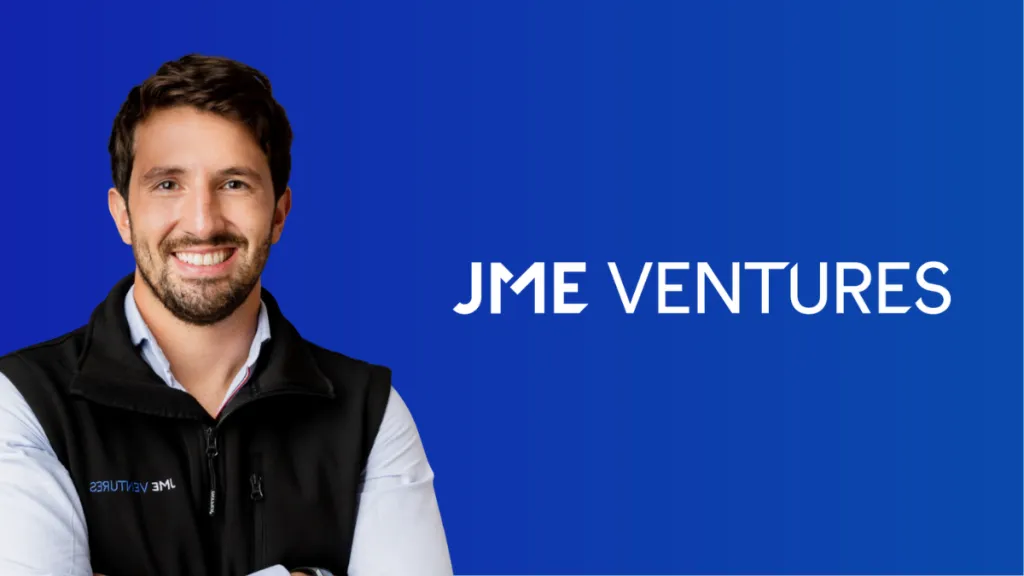
How content became Iván’s competitive advantage in VC
Iván did not set out to become a content creator. The instinct came from Naval Ravikant’s almanac, specifically the idea that in the internet era, leverage no longer comes only from capital and people. Code and content are the new forms of leverage, with a marginal cost of reproduction close to zero. You write something once, it travels infinitely.
He started anonymously on Twitter under the handle Startup Riders, because as a Facebook employee he could not easily publish under his own name. He built a Google Sheet of Spanish startup ecosystem resources, investors, funds and angels, organized and filterable in a way that nothing else was at the time. That sheet ended up in TechCrunch. The newsletter followed on Substack in July 2020, before almost anyone in Spain’s VC world was doing it.
I do not really like the term content creator. I try to summarize and write things that seem useful to me and to others. If people want to read it, great. If not, no problem. The benefit is that it attracts people who think like you.
Iván Landabaso
80K LinkedIn followers
26K Substack subscribers
17K Twitter followers
The growth was not linear. It took four years on Substack to reach 10,000 subscribers. The next year alone added 16,000 more. Compound interest, applied to content.
What makes the content flywheel work for an investor specifically: posts about startup funding rounds attract founders who are raising. Lists of companies hiring attract candidates who are looking. Both groups are exactly the people a pre-seed investor wants relationships with. No cold outreach needed. The content brings the deal flow.
The LinkedIn opportunity was particularly well-timed. LinkedIn’s algorithm rewards consistency and the bar for differentiation on a platform people associate with cringe corporate posts is low. One million impressions per month with posts that share honest observations rather than polished thought leadership.
JME Ventures: fund history, returns and what they look for
JME is an independent venture capital fund focused primarily on Spanish founders, whether based in Spain or internationally. The fund has been running since 2012 and is now on its fourth vehicle.
JME fund history
- Fund I (2012): approximately €16 million
- Fund II: approximately €40 million
- Fund III: approximately €50 million, vintage 2020, caught difficult valuation environment
- Fund IV: approximately €50 million, currently deploying
- Focus: pre-seed and seed, sector agnostic, Spanish geography or Spanish founders globally
- Portfolio includes: PLD Space, Multiverse Computing, Flywire, Lingo Kids
Fund I is tracking toward approximately 3x net returns. The headline company was sold earlier than ideal: had JME held, the fund would have returned roughly 10x. A hard lesson about timing exits in a market where the best outcomes take a decade or more to fully materialize.
Fund II still has several companies unrealized, including Lingo Kids and PLD Space, which recently closed a €150 million Series C. Fund III is the most uncertain, having deployed during the high-valuation years of 2020 and 2021. The team is small, six or seven people, and deeply relationship-driven.
Why venture capital is overhyped in Spain
One of Iván’s most pointed observations: in Spain, an immature ecosystem, venture capital has become disproportionately visible in a way that distorts how people think about entrepreneurship.
Venture capital should be less than 1% of the economy. But it appears that if you do not have venture capital, you cannot be an entrepreneur. Nothing could be further from the truth.
Iván Landabaso
The companies most people in Spain associate with business success, Mercadona, Inditex, were built without a single euro of venture capital. They were ambitious, they scaled, they became global. VC is not a prerequisite for building something great. It is a specific tool for a specific type of business with specific capital requirements and timelines.
The book he recommends on this: Small Giants by Bo Burlingham, which profiles companies that consciously chose to build great businesses at a sustainable scale rather than optimizing for maximum growth at any cost. More of these companies would be good for Spain’s economy and for the broader culture of entrepreneurship.
What Iván actually looks for in founders
At pre-seed, there is rarely enough data to run a rigorous analysis. No revenue to model, no product-market fit to verify, often no clear market size to point to. So what does a good early stage investor actually do?
What Iván looks for
- Pattern recognition built from years of exposure to exceptional people
- Founder quality and ambition above all else at pre-seed
- A team with genuinely diverse perspectives, not consensus
- The gut sense that someone will find a way regardless of the starting idea
What actually kills companies
- Market: wrong timing, non-existent demand, or a wave that does not come
- A great team in the wrong market will often still fail
- A mediocre team in the right market at the right time can still succeed
- Nobody has a crystal ball on market timing
The analogy Iván uses is a plate of lentils. You know it is good before you can explain exactly why. Pattern recognition works the same way in investing. You have been in enough rooms with enough exceptional people that you develop an instinct for what potential looks and feels like, separate from what the spreadsheet says.
He is also honest about the limits of any framework. Sometimes the best investment is the one where one person slams their hand on the table and says this has to happen, and everyone else in the room disagrees but goes along. Early stage investing is artisanal. It cannot be fully institutionalized, which is why the best pre-seed funds stay small and relationship-driven.
You can run all the checklists you want. Porter five forces, defensibility, international from day one. But sometimes you have to throw all of that away and make the investment anyway, because of something you cannot fully articulate. That is why it is artisanal.
Iván Landabaso
The ATM analogy: AI and the future of jobs
Iván does not pretend to have a definitive answer on whether AI will destroy more jobs than it creates. Nobody does. But the historical analogy he finds most useful is the ATM.
When cash machines arrived in the United States, bank employees feared mass unemployment. The opposite happened. The ATM automated the mechanical part of the job, which freed up the branch to expand into financial advisory services. More people ended up employed in banking than before, and consumers got more value. The level of abstraction rose. The human moved up the value chain.
The same dynamic appears to be happening in software engineering today. Cheaper code production should increase demand for software, because much of the software that previously was not worth building becomes economical. Early data suggests software engineering job postings have been rising since large language models became widely available, not falling.
The question nobody can answer: what happens if the technology improves to the point where human abstraction cannot keep pace? Iván’s honest position is that he leans toward the ATM outcome, but he holds it with humility. The pessimist case is not unreasonable.
What he is more confident about: highly relational work will be the last to go. B2B sales in complex deals. Healthcare conversations. Experiential businesses. The recent explosion of specialty coffee shops, ceramics workshops and run clubs in cities is not an accident. As digital output becomes abundant, authentic human experiences become scarcer and more valued.
Why Revenue Squared exists and why Nova bought it
Iván and Jorge Bestart co-founded Revenue Squared with a thesis that is essentially the same one behind Nova: the talent is there, the community is not. In Spain, too many people with excellent commercial skills end up in consulting or banking simply because nobody has shown them that B2B tech sales is a genuinely great career path, often better paid, more meritocratic and more resilient than the prestige alternatives.
The validation process was quick and empirical. Before building anything, Iván and Jorge had 30 to 50 conversations with potential members, told them upfront it would cost money, and closed the first 20 to 30 paying members before they had a proper product. When people pay, they are telling you something real. When they stay, they are telling you something more.
Revenue Squared grew to nearly 500 members through entirely organic means: no paid marketing, no growth hacks, just consistently useful content, rigorous individual entry interviews and events that people genuinely wanted to attend. The Revenue Talks and Drinks format regularly drew over 150 people. Companies have been founded through the Slack. Career changes have happened because of a course. Friendships have become partnerships.
The fit with Nova was visible before either side had named it. Both communities filter for quality at entry. Both believe the network itself is the product. Both are trying to elevate the status of careers that Spain undervalues. And Nova’s horizontal reach across 80+ countries is exactly what Revenue Squared members have been asking for since the beginning.
A non-linear career from Brussels to Barcelona
Iván was born in Brussels, grew up moving between cities because of his parents’ work at the European Commission, and spent most of his twenties outside Spain. Economics at Sussex, a master’s at LSE, another at Cambridge, a short stint at the OECD in Paris working on Latin American entrepreneurship ecosystems, then California for a year and a half at Bloombridge (a seed-stage search and AI company that is now worth over $2 billion), then Facebook in London on the augmented reality and face filters team, then back to Spain.
None of it was planned in a straight line. He did not do the Icade-to-McKinsey-to-startup track that many of the people he studied with pursued. He says he barely applied to investment banks in 2011, partly because everyone else was doing it and he had always had a slight resistance to following the herd.
If your path is not the pre-established one, that is fine. There are many ways to go far. Curiosity, movement and ambition matter more than which door you walked through at 22.
Ramón Rodrigáñez, reflecting on Iván’s career
The most formative professional experience he names is the SDR role at Bloombridge. Cold calling. Rejection. Starting over. He says every founder and investor should do it at least once: nothing teaches you faster what it feels like to be on the other end of a sales conversation, and nothing builds the resilience that makes everything harder that follows feel manageable by comparison.
Takeaways from this episode
- Content compounds like interest. Four years to reach 10,000 Substack subscribers, one year to add 16,000 more. The flywheel only accelerates if you keep building it.
- Venture capital should be less than 1% of the economy. In Spain it gets far more attention than that, which distorts how people think about entrepreneurship. Most great businesses have never taken VC money.
- At pre-seed, team quality matters more than the idea. The idea will change. The market will ultimately determine whether the company succeeds. Nobody can reliably predict market timing.
- Early stage investing is artisanal. Pattern recognition built from years of exposure to exceptional people is not replaceable by a checklist.
- The ATM analogy: AI may raise the level of abstraction for human work rather than eliminate it, just as ATMs led to more financial advisors, not fewer bank employees. But nobody knows for certain.
- Relational work, complex B2B sales, experiential businesses and deeply human services will be the last categories AI displaces.
- Revenue Squared grew to 500 members with zero paid marketing. Quality of curation and genuine peer-to-peer value are more powerful growth levers than any ad campaign.
- A non-linear career through many functions and geographies is not a weakness. It is often how the most interesting investors and operators are built.
Nova Membership · Applications open
The network where the most ambitious professionals connect.
Nova connects over 25,000 high-potential professionals across 80+ countries. Merit-based selection. Curated events. A community that includes the founders, investors and operators shaping the next chapter of European tech.